The fastest dragon flag progression goes from leg raises to tuck flags to slow negatives, and only then to the full rep. Most people stall because they skip the negatives or let their hips bend. Below is a 6-step ladder with a clear test for moving up, the form cues that matter, and a plan you can run two or three times a week.
What does a dragon flag train?
A dragon flag mainly trains the abs, with the obliques and lats working hard to hold the body rigid. StrengthLog lists the abs as the primary mover, with the obliques and lats as secondary. Your hip flexors and glutes help keep the legs in line, and your grip and upper back hold you in place.
It is a long-lever move. Your whole body acts as one straight plank pivoting at the shoulders, which is why it is so much harder than a crunch or leg raise. The slow lowering phase is where most of the work happens.
What do you need to grip for a dragon flag?
You need something solid behind your head that will not move when you pull on it. That is the anchor problem. Most people use a bench edge, a heavy bench leg or a pole. A couch or a light bench tends to tip or slide once your legs go up, which kills the rep.
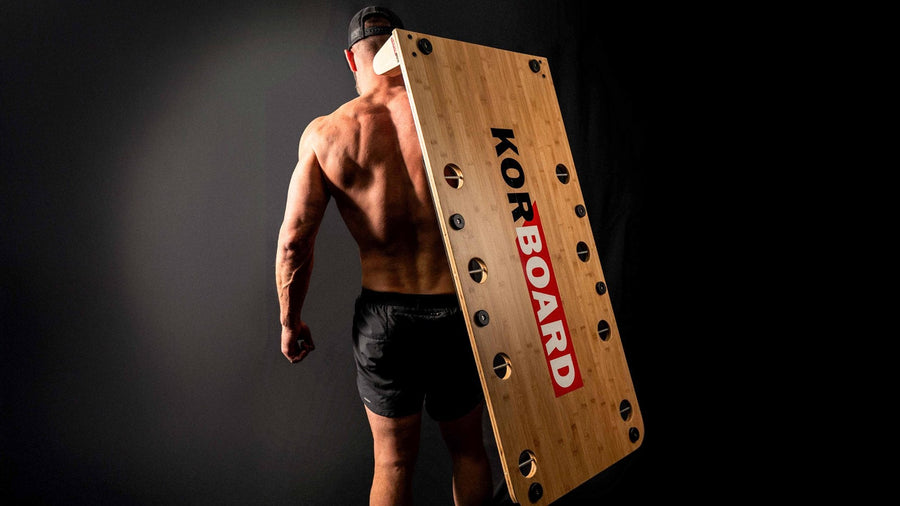
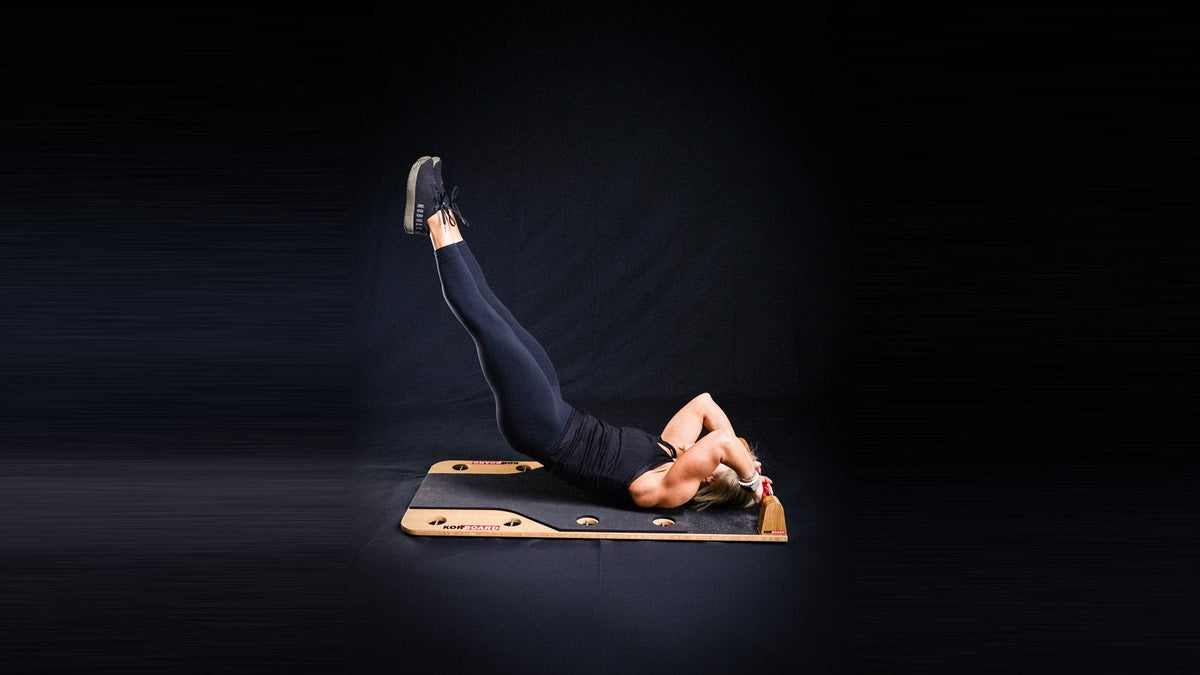
On a KORBOARD, you lie on the board and grip its anchor end behind your head. Because your shoulders and upper back stay on the board, your body weight pins it to the floor while you pull. We make the KORBOARD, so we are biased, but it solves the anchor problem without a bench. The non-slip matting also keeps your upper back from sliding.
What is the best dragon flag progression?
Work through six steps, in order. Stay on each step until you hit the test in the right column with clean form, then move up. Most people need several weeks per step in the middle of the ladder. Negatives (step 5) are the step you should not rush, because they build the strength the full rep needs.
| Step | Exercise | How to do it | Move up when you can do |
|---|---|---|---|
| 1 | Lying leg raise | Lie flat, grip behind your head, raise straight legs to vertical and lower slowly without your lower back arching. | 3 sets of 12, lower back flat |
| 2 | Reverse crunch | From knees bent, curl your hips off the floor toward your chest, then lower one vertebra at a time. | 3 sets of 12, no swinging |
| 3 | Tuck dragon flag | Roll up onto your upper back with knees tucked to your chest, hips straight. Lower slowly, keeping the tuck. | 3 sets of 6, 3-second lowering |
| 4 | Single-leg dragon flag | Same as the tuck, but extend one leg straight and keep the other tucked. Alternate legs each set. | 3 sets of 5 per leg, hips straight |
| 5 | Dragon flag negative | Get to the top any way you can, then lower your straight body as slowly as possible, stopping just above the floor. | 3 sets of 5, 5-second lowering |
| 6 | Full dragon flag | Lower with a straight body, pause just above the floor, and raise back up without bending at the hips. | 3 sets of 3 to 5 |
You can find the earlier steps and other core moves in our exercise library.
How do you do a dragon flag with good form?
Think of your body as one rigid board from shoulders to toes. Your weight rests on your upper back and shoulders, never your neck. Grip hard behind your head, squeeze your glutes, point your toes, and keep your ribs pulled down. Lower slowly, stop before you touch the floor, then pull back up as one piece.
- Grip: pull the anchor toward you as if you were trying to bend it. That tension holds the top position.
- Hips: stay straight. The line from shoulders to ankles should not break.
- Lower back: stays slightly rounded (hollow), not arched.
- Tempo: 3 to 5 seconds down. Rushing the lowering is where people lose position.
What are the most common dragon flag mistakes?
The two big ones are hips piking and the lower back arching. Piking means bending at the hips to shorten the lever, which turns the move into a reverse crunch. Arching means letting your lower back sag toward the floor, which shifts strain onto the spine. Both mean you are on a step that is too hard.
- Hips piking: drop back to single-leg flags or negatives until you can hold a straight line.
- Lower back arching: stop the rep higher, squeeze the glutes, and pull your ribs down.
- Weight on the neck: roll onto your upper back and shoulder blades, not the back of your head.
- Weak anchor: if the bench slides or tips, fix the anchor before adding reps.
- Training it every day: this is a hard move. Give your core time to recover.
How should you program dragon flag training?
Train the dragon flag two or three times a week, on non-consecutive days, early in your session when you are fresh. Keep the reps low and the quality high: 3 to 4 sets of 3 to 8 reps, with 90 seconds to 2 minutes of rest. Stop each set when your form breaks, not when you are exhausted.
| Day | Main work | Accessory |
|---|---|---|
| Day 1 | Your current step, 4 sets of 3 to 6 | Hollow body hold, 3 x 20 to 30 seconds |
| Day 2 | One step down, 3 sets of 8 to 10 | Lying leg raise, 2 x 12 |
| Day 3 (optional) | Your current step, 3 sets of 3 to 5 | Plank, 3 x 30 to 45 seconds |
If you are new to training, start with our guide to starting a workout routine without overthinking it, then come back to step 1.
FAQ
How long does it take to learn a dragon flag?
It depends on your starting strength. Someone with solid leg raises might reach full reps in a few months. A beginner should expect longer. Progress through the ladder rather than counting weeks.
Are dragon flag negatives enough on their own?
They are the most important step, but pair them with tuck and single-leg flags so you also build strength on the way up.
Can I do dragon flags on the floor?
Yes, as long as you have something solid to grip behind your head. A KORBOARD gives you an anchor end to hold, and you can follow core work in the free KORBOARD app.